
![]() |
What should I look for in an awning professional? Will awnings reduce my air-conditioning costs?
|
| CITY | EQUAL ORIENTATION
|
EAST ORIENTATION
|
SOUTH ORIENTATION
|
WEST ORIENTATION
|
||||||||||||||||||||||||||||||||||||||||||||||||||||||||
| Minneapolls Boston Beatic Albuquerque Phoenix St.Louis Sacramento |
|
|
|
|
Note: The annual energy performance figures shown here were generated using RESFEN for a typical (new construction) 2000 sq ft house with 300 sq ft of window aera. In the first case, the windows are equally distributed on all four sides of the house. Where windows are predominately on one side, the distribution is 240 sq ft on that side and 20 sq ft on the others. U-sactor and SHGC are for the total window including frame. RESFEN is a computer program for calculating the annual cooling and heating energy use and costs due to window selection. It is available from Lawrence (windows.lbl.gowsoftware???)
Acknowledgements: This report was developed with support from the Professional Awning Manufacturers Association (PAMA). In particular, we appreciate the input from Michelle Sahin, Managing Director of PAMA, who initialized and shaped aging Director of PAMA, who initiated and shaped the project. The Windows and Glazings Program at Lawrence Berkeley National Laboratory (LBNL) was a significant partner in conducting the study.
If there are no poles, what supports the unit?
Retractable awnings have been designed to be self-supporting. This style of awning relies on secure mounting in conjunction with spring-loaded arms. The arm tension is created with internal springs, and large radius elbows keep the fabric tight by applying outward force.
When would I need a protective hood?
Protective hoods, available at an additional cost, have been designed to provide adequate unit protection when structural protection is not available. Hoods often are purchased when the retractable awning is being roof or fascia-mounted and when not located directly under a soffit or overhang.
Are there any other weather conditions I should be concerned about?
Retractable awnings primarily are designed to provide protection from the sun's rays and not from rain. However, it can be used in drizzle or misting rains with proper unit pitch. In heavy or driving rains or wind, the unit must be retracted to keep water from "pooling" on the fabric and causing damage or irreversible fabric stretching.
How will my retractable awning mount to my facility?
Installers locate the structural framework and pre-drill the mounting bracket holes through any siding to tie in directly to either the wall studs or headers. On roof-mount applications, the installers tie into the rafters, pre-drilling to avoid cracking and silicone-caulking the hardware and brackets to prevent leaks.
What does an average-sized retractable awning cost?
Because most retractable awnings are customized for each residence, prices cannot be given without verified measurements and on-site inspection. Your awning supplier typically can meet with you for a free, in-home consultation to design an awning that's right for you.
What kind of wind loads can a retractable awning handle?
Retractable awnings primarily are for sun protection and should not be left out in windy conditions. However, wind is a very unpredictable force, with a tendency to change direction and speed very quickly. In a wind-tunnel test, which is a very controlled environment, a retractable awning withstood straight-on wind forces at over 50 mph. In "real-life" applications, the general rule of thumb is: If you are comfortable sitting outdoors dining or reading the paper, then it is probably safe to operate your awning. The concern with wind is the up-lifting effect on the awning rather than the downward force; therefore the greater the pitch, the more wind-resistant the unit is.
Why would I want my retractable awning motorized?
Nothing could be more convenient than simply flipping a switch and watching your awning roll out on its own. Once fully extended or retracted, the unit will stop automatically. You may also stop the retractable in any position by flipping a wall-mounted switch or pushing a button on a remote. Research has shown that a motorized awning is used four times as much as a manual unit.
Do I need a building permit for an awning?
Not for most residential awnings. However, almost all commercial situations, especially in major metropolitan areas, do require a permit. In some areas, more than one, such as one for graphics and another for historic district approval. Your awning professional is very knowledgeable about when and where permits are required.
I live in a development governed by a homeowners' association. Are awnings allowed there?
Because canvas awnings are colorful, attractive, energy-saving design features, most homeowners' associations are receptive to adding them to the exterior decor of a building. Typically, the association's architectural committee reviews these questions. Many developments work with a local awning professional so that the awning styles and colors are consistent throughout the development.
Will awnings protect my furniture from fading?
Awnings, just as other interior window products, protect furniture, floors and carpets from fading caused by harsh sun rays. However, unlike interior products, awnings give the added benefit of energy savings by reducing the solar radiation through glass windows and doors.
Will my awning protect me from the sun's harmful rays?
Not only does an awning protect you from the sun, but it also protects you from the other natural elements, such as rain and snow. In certain configurations, awnings can also protect you from wind. As in many shade options, the amount of protection from the sun's harmful ultra violet rays would be determined by the type and color of the fabric. Your Professional Awning Manufacturer can help you meet your requirements, through the proper fabric selection.
If I purchase a traditional patio awning, can the frame be dismantled for the hurricane months?
Yes it can. However, it's important that you inform your Professional Awning Manufacturer of this requirement, so that the awning is designed for this purpose and the proper slip fittings are used. Many homeowners remove the fabric and leave the frame up over the hurricane season.
What is the support frames made from? How durable are they?
Metal support frames are made from either galvanized steel or aluminum and will last a lifetime! Regular maintenance on a frame requires annual inspections of fasteners, connections and metal condition. Frames are also available with a painted finish for additional protection and attractiveness.
Does an awning need to be fire retardant?
If the awning will be installed at a commercial site, your local Professional Awning Manufacturer can advise you on the local "code" requirements. Localities vary, but many require flame retardant fabric, in locations of public gathering. The use of a flame retardant fabric will usually increase the cost of your awning. In residential applications not governed by local codes, the requirement to use a flame retardant fabric becomes a personal preference. Flame retardant fabrics are available in a wide variety of colors and styles.
Does my awning come with a warranty?
In many cases, awning fabrics are warranted for a period of 5 years or more, in proportion (pro-rate) to the useful life of the fabric. Other warranties regarding the frame and workmanship may apply and vary by job and by state. See your Professional Awning Manufacturer for more details pertaining to your particular project. Special warranties are available upon request, ask your sales associate about warranties.
Are awnings waterproof? Can I stay out under my awning in inclement weather?
Generally speaking, awning fabrics are water-repellent, not waterproof. There are exceptions, though, which may be practical in certain environments. The fabrics' water-repellent characteristics allow you to fully enjoy the space shaded by the awning during any weather conditions that aren't severe. In other words, if the weather is nice enough for you to be outside, then it is good enough for you to be out underneath your awning.
What colors are available?
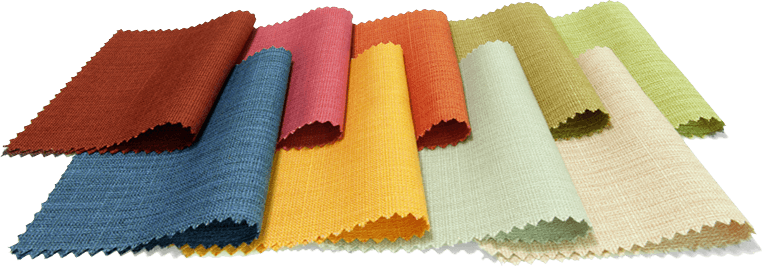
Today's fabrics come in more than 500 solid and striped colors! Remember, too, that most of the time you are enjoying your awning you are relaxing underneath it (not outside looking at it), so the underside color is probably the one you will see more often. With so many colors to choose from you are bound to find several that will enhance the look of your home or building.
Does the fabric color I choose affect how hot it is under my awning? or, for that matter, how dark it will be shaded underneath?
Good question. Of course, the darker the color chosen, the darker the shade effect underneath will be. There are exceptions, however. Certain fabrics have a lighter-colored underneath side than the top-side color, which gives a more pleasing shading effect. As for the temperature, while color choice has some slight impact, the type of fabric chosen and the overall ventilation of the installation will have a greater effect. Again, your awning professional is well qualified to assist you in this aspect of the awning design.
Is there much difference between the various types of awning fabrics?
Yes, different fibers, weaves and coatings have very specific advantages. Some fabrics are breathable, some are not. Acrylic fabrics have a rich cloth appearance and are much more colorfast and fade resistant. Vinyl coated fabrics are the most water repellent. Mesh fabrics allow better ventilation and outward visibility. Your awning professional will help you make the best selection.
How many styles of awnings are there?
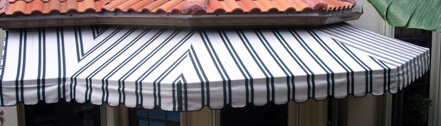
Awnings can be made to almost any size or shape. With the use of modern metal fabrication equipment and techniques coupled with many new fabric seaming and attachment methods, design options are literally limitless. Examples of awning styles can be found in the Phto Gallery. For illustrations of standard awning styles go to the Photo Gallery on the navigation tool bar.
How do I store my awnings in the hurricane season?
Many Professional Awning Manufacturers offer a removal and storage service for awnings and canopies. If you prefer to do this yourself, make sure to clean and dry your awnings before you store them. Give them a final brushing to remove all debris. Fold or roll the awnings, then cover and store them in a cool, dry place. We also offer this service to our customers.
Can I apply graphics to my awning?
Yes, the type of graphics and method of application would depend on the fabric selection, as various fabrics accept different applications. Applying graphics directly to awning fabrics provides identification and/or advertisement without the need for "add-on" sign structures. Consult a PAMA member company to ensure using the appropriate graphic application.
What should be done with a retractable awning in the winter?
By design, the awning is self-storing when retracted. Many owners of retractable awnings remove the loose hanging valance for winter storage, while others do nothing more than keep the unit retracted and bring the crank handle in. And some owners use their retractable awnings all year long!
What should I look for in an awning professional?
You should seek a firm that is an active member of the Professional Awning Manufacturers Association (PAMA). In addition, some PAMA members are certified Master Fabric Craftsman * the highest level of certification offered by the Industrial Fabrics Association International (IFAI). IFAI is the worldwide trade association for the specialty fabrics industry. Beyond that, lastly, ask for reference of other similar work provided by the firm you are considering, along with a photographic portfolio of work the firm has done. Of course, if the firm has a showroom, pay a visit. An awning professional will be able to provide you with information about awning design and choice of fabric.
Should I attempt to clean my awning, rather than use a professional awning cleaning service?
You can clean it yourself or use the services of a reputable professional awning cleaner. If you clean it yourself, it's important to follow these instructions: 1. If your awning is located in a commercial area, close off the area to customers and pedestrians. 2. Brush off all debris. 3. Clean from the bottom and work up. 4. Scrub the awning and valance with a soft bristled brush. 5. Cover all parts of the awning. Missed spots will show when dry. 6. Rinse the awning completely. Film left on the material will leave marks and a chalky residue. 7. Occasionally rinse your awning down with a garden hose and keep the underside of your awning clean by simply brushing with a clean household broom. We recommend using the cleaning service we offer.
How long does it take to manufacture and install an awning?
As with any custom-manufactured product, there is a short lead time for quality work to be accomplished. For canvas awnings, this can mean as little as three weeks. Of course, this varies depending on the time of the year (summer typically is the busiest part of the year), and it is not unusual for this lead time to run longer, especially in seasonal climates. If it is a permitted job times will vary on permits, depending on city.

go to top